Visa Types Explained: Your Complete 2026 Guide to Moving, Studying & Working in Canada
Introduction: Why Canada Is the World’s Top Immigration Destination in 2026
Canada consistently ranks as one of the best countries in the world to live, work, and study in — and it’s not hard to see why. With a welcoming multicultural society, world-class universities, a strong job market, and one of the most transparent immigration systems on the planet, Canada attracts hundreds of thousands of newcomers every year.
In fact, Immigration, Refugees and Citizenship Canada (IRCC) welcomed over 400,000 new permanent residents in recent years, with plans to maintain or grow that number. Whether you’re dreaming of a Canadian adventure, an international degree, a career breakthrough, or a chance to be reunited with your family — Canada has a visa pathway for you.
But here’s the thing: applying for the wrong visa type is one of the most common — and costly — mistakes applicants make. It wastes time, money, and in some cases, damages your future immigration chances.
This guide breaks it all down for you. Simply, clearly, and completely.
What Is a Canadian Visa and Do You Always Need One?
A Canadian visa is official permission granted by the Government of Canada that allows a foreign national to enter and stay in Canada for a specific purpose and duration. It is issued by IRCC (Immigration, Refugees and Citizenship Canada) and linked to your passport.
Not everyone needs a visa to enter Canada. Citizens of certain countries are visa-exempt and only need an Electronic Travel Authorization (eTA) to fly into Canada. However, if you’re from a country that is not visa-exempt — which includes many nations from South Asia, Africa, and the Middle East — you will need to apply for the appropriate visa before travelling.
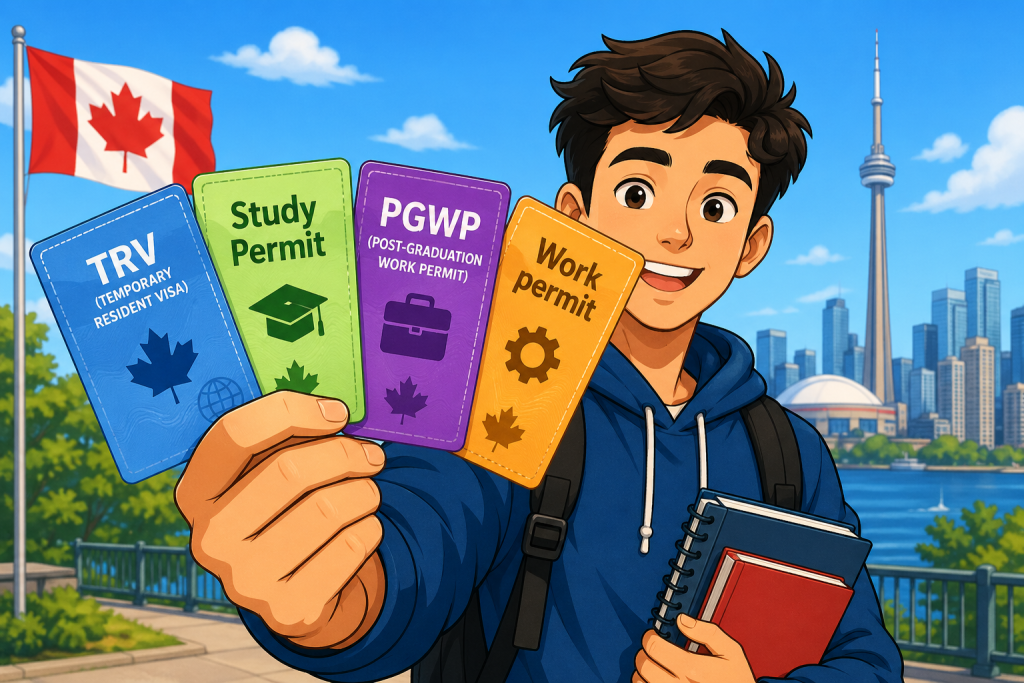
There are four major visa categories that most people need to understand:
- Tourist Visa (Temporary Resident Visa)
- Student Visa (Study Permit)
- Work Visa (Work Permit)
- Family Reunification (Spousal & Family Sponsorship)
Let’s dive into each one.
1. Canada Tourist Visa (Temporary Resident Visa — TRV)
What Is a Canada Tourist Visa?
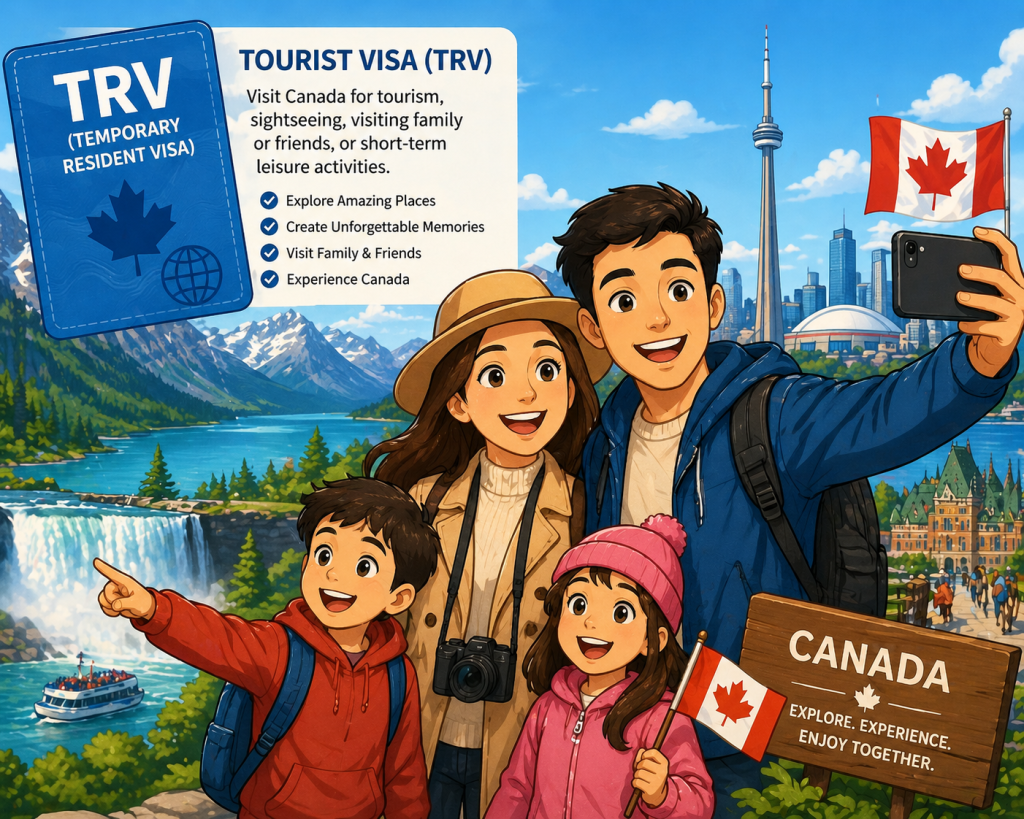
The Canada Tourist Visa, officially known as a Temporary Resident Visa (TRV), is a document placed in your passport that shows Canadian border officials you have been approved to enter Canada for a temporary stay. It is the most common visa type applied for, and is ideal for:
- Vacations and sightseeing
- Visiting family or friends already living in Canada
- Attending short events, weddings, or graduations
- Medical treatment
How Long Can You Stay on a Canada Tourist Visa?
Most visitors are allowed to stay in Canada for up to 6 months from the date of entry. A border officer determines the exact duration at the port of entry. In some cases, you can apply to extend your stay from within Canada, but this must be done before your current status expires.
Can You Work or Study on a Tourist Visa?
No. A Tourist Visa strictly prohibits you from working or enrolling in any long-term academic programs in Canada. Attempting to work on a visitor visa is a serious immigration violation and can result in removal from Canada and future bans.
Who Should Apply for a Canada Tourist Visa?
You need a TRV if you are a citizen of a country that is not visa-exempt. This includes nationals from countries such as Pakistan, India (certain cases), Nigeria, Bangladesh, Philippines, and many others. You can check IRCC’s official list to confirm whether your country requires a TRV.
Key Documents Required
- Valid passport (at least 6 months validity beyond your planned stay)
- Completed visa application form (IMM 5257)
- Recent passport-sized photographs
- Proof of financial support (bank statements)
- Proof of ties to your home country (employment letter, property, family)
- Travel itinerary or invitation letter (if visiting family)
- Biometrics (required for most applicants)
Processing Time & Fees
Tourist visa processing times can vary from 2 to 8 weeks depending on your country of application and current IRCC volumes. The government application fee is CAD $100, and biometrics cost an additional CAD $85.
Pro Tip
A strong application clearly shows the visa officer that you have genuine reasons to return to your home country after your visit. Ties like a stable job, family, property ownership, or a business all strengthen your tourist visa application significantly.
2. Canada Student Visa (Study Permit)
What Is a Canada Study Permit?
A Canada Study Permit is the official document that allows international students to study at a Designated Learning Institution (DLI) in Canada. Canada is consistently ranked among the top 3 countries in the world for international education, and it’s easy to understand why — world-class universities, affordable tuition compared to the US and UK, and generous post-study work rights make it incredibly attractive.
Popular institutions include the University of Toronto, McGill University, University of British Columbia, University of Waterloo, and hundreds of colleges and polytechnics across provinces like Ontario, British Columbia, Quebec, and Alberta.
Who Needs a Canada Study Permit?
You need a Study Permit if you plan to study in Canada for more than 6 months. Short-term language courses under 6 months may be covered by a tourist visa, but any formal academic program — diploma, bachelor’s, master’s, or PhD — requires a Study Permit.
Can You Work While Studying in Canada?
Yes — and this is one of the biggest advantages of studying in Canada. As an international student with a valid Study Permit, you are allowed to work:
- On campus: Unlimited hours
- Off campus: Up to 24 hours per week during academic sessions (recently updated from 20 hours)
- Full-time during scheduled breaks: Summer, winter holidays, and reading weeks
This means you can earn while you learn, helping to offset your living and tuition costs.
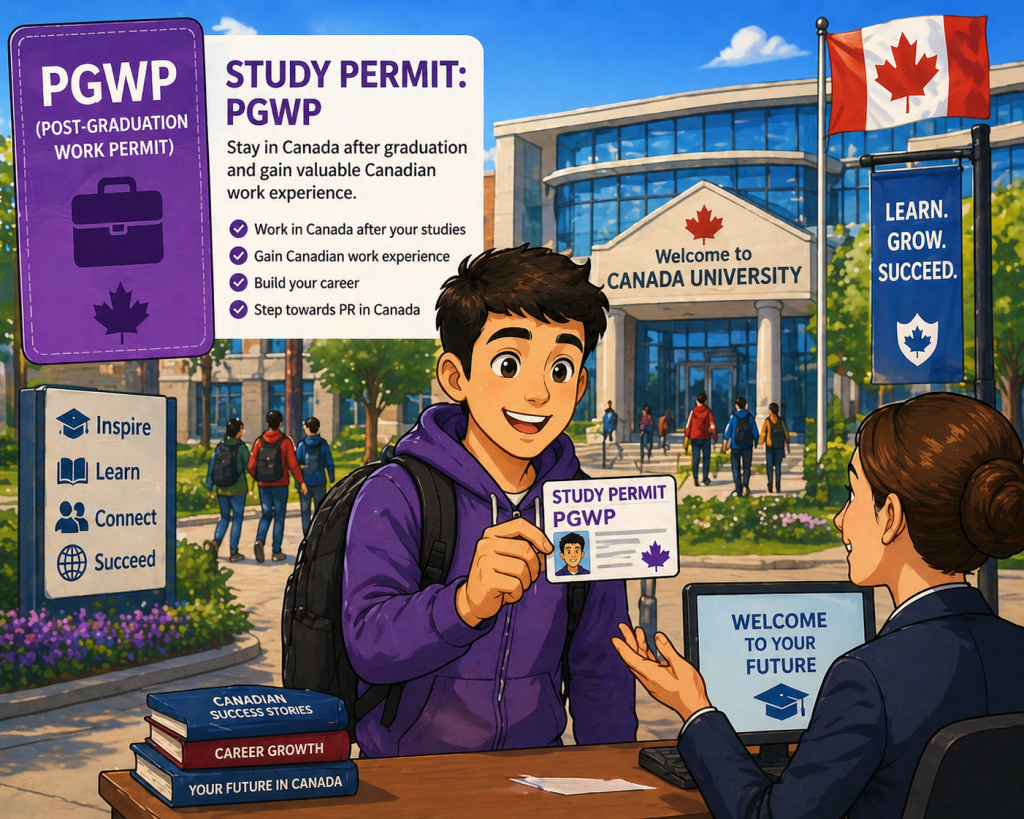
Post-Graduation Work Permit (PGWP)
One of Canada’s biggest draws for international students is the Post-Graduation Work Permit (PGWP). After completing a program of at least 8 months at a DLI, you may be eligible for a PGWP that allows you to work in Canada for up to 3 years after graduation. This work experience then becomes a direct pathway to Canadian Permanent Residency (PR) through programs like the Canadian Experience Class (CEC) under Express Entry.
Key Documents Required
- Letter of Acceptance from a Designated Learning Institution (DLI)
- Valid passport
- Proof of language proficiency (IELTS, TOEFL, Cambridge C2 Proficiency, PTE, etc.)
- Proof of financial support (tuition + living expenses — approximately CAD $20,000+ per year)
- Statement of Purpose (SOP) / Study Plan
- Academic transcripts and certificates
- Medical exam (in some cases)
- Biometrics
Processing Time & Fees
Study Permit processing times vary widely — online applications can be processed in 4 to 16 weeks. The government fee is CAD $150. Many applicants now apply through the Student Direct Stream (SDS) if eligible, which can reduce processing times to as little as 20 business days.
Pro Tip
Your Statement of Purpose (SOP) is one of the most important parts of your Study Permit application. Clearly explain why you’ve chosen Canada, why this specific program, and how it connects to your career goals back home. A strong SOP can significantly increase your chances of approval.
3. Canada Work Visa (Work Permit)
What Is a Canada Work Permit?
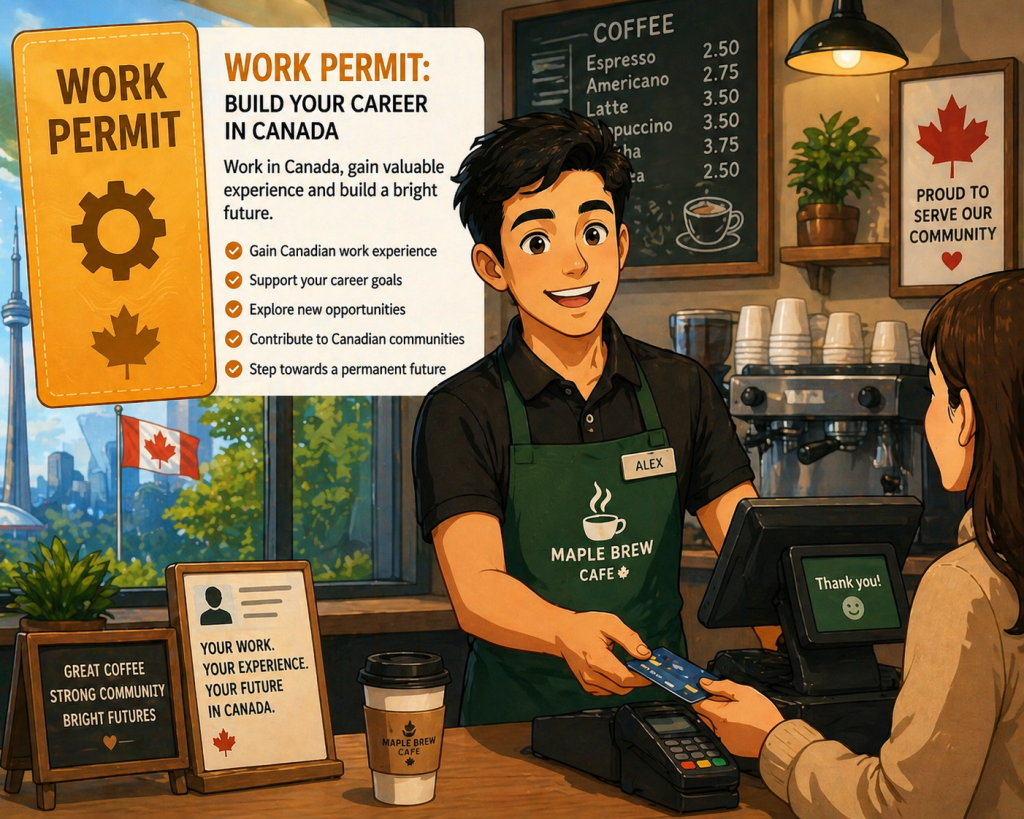
A Canada Work Permit is a document that legally authorises a foreign national to work in Canada for a specified employer, occupation, or in any job (depending on the type). Canada’s booming economy and massive labour shortages in sectors like healthcare, technology, construction, trucking, and agriculture make work permits one of the most in-demand visa categories.
Types of Canada Work Permits
There are two main categories of Canadian Work Permits:
a) Employer-Specific Work Permit (Closed Work Permit) This permit ties you to a specific employer, job location, and duration. To get this type, your employer usually needs to obtain a Labour Market Impact Assessment (LMIA) — a document proving that no Canadian citizen or PR was available to fill the role.
b) Open Work Permit This is the most flexible type. An Open Work Permit allows you to work for almost any employer in Canada without needing a specific job offer. You are eligible for an Open Work Permit if you are:
- A spouse or partner of a skilled worker or international student
- A recent graduate applying for a Post-Graduation Work Permit (PGWP)
- An applicant with a pending PR application
- A refugee claimant or protected person
Pathways to Getting a Canadian Work Permit
There are multiple routes to obtaining Canadian work authorisation:
- Express Entry (Federal Skilled Worker, CEC, Federal Skilled Trades) — points-based immigration system for skilled professionals
- Provincial Nominee Programs (PNPs) — provinces like Ontario, Alberta, BC, and Saskatchewan nominate workers in high-demand fields
- International Mobility Program (IMP) — work permits issued without an LMIA under international agreements like CUSMA (formerly NAFTA)
- Temporary Foreign Worker Program (TFWP) — LMIA-based work permits for specific employers
- Atlantic Immigration Program — for employers in Atlantic provinces (Nova Scotia, New Brunswick, PEI, Newfoundland)
In-Demand Jobs in Canada in 2026
Canada is actively recruiting workers in several high-demand sectors:
- Healthcare (nurses, personal support workers, medical technicians)
- Technology (software developers, data analysts, cybersecurity experts)
- Trades (electricians, plumbers, welders, carpenters)
- Transportation (truck drivers, logistics coordinators)
- Agriculture (seasonal farm workers)
- Hospitality and food services
Key Documents Required
- Valid job offer letter from a Canadian employer (for closed permits)
- LMIA (Labour Market Impact Assessment) if required
- Valid passport
- Proof of qualifications and work experience
- Police clearance certificate
- Medical examination results (for certain roles)
- Biometrics
Processing Time & Fees
Work permit processing times range from 2 weeks to several months depending on the stream and your country of residence. Government fees are CAD $155 for a single work permit.
Pro Tip
If you’re looking to work in Canada long-term, focus on building your Comprehensive Ranking System (CRS) score for Express Entry. A higher CRS score dramatically increases your chances of receiving an Invitation to Apply (ITA) for permanent residency.
4. Family Reunification — Sponsoring Your Loved Ones to Canada
What Is the Canada Family Sponsorship Program?
Canada places enormous value on keeping families together. The Family Sponsorship Program, managed by IRCC, allows Canadian citizens and permanent residents to sponsor their eligible family members to come to Canada as permanent residents. This is one of the most emotionally significant and legally complex visa categories.
Who Can Be Sponsored?
Canadian citizens and PRs can sponsor:
- Spouses, common-law partners, and conjugal partners (most common)
- Dependent children (under 22 years old, unmarried, and not a full-time student supporting themselves)
- Parents and grandparents (through the Parents and Grandparents Program — PGP)
- Other relatives in specific limited circumstances (e.g., orphaned siblings, nieces/nephews)
Spousal Sponsorship — The Most Common Route
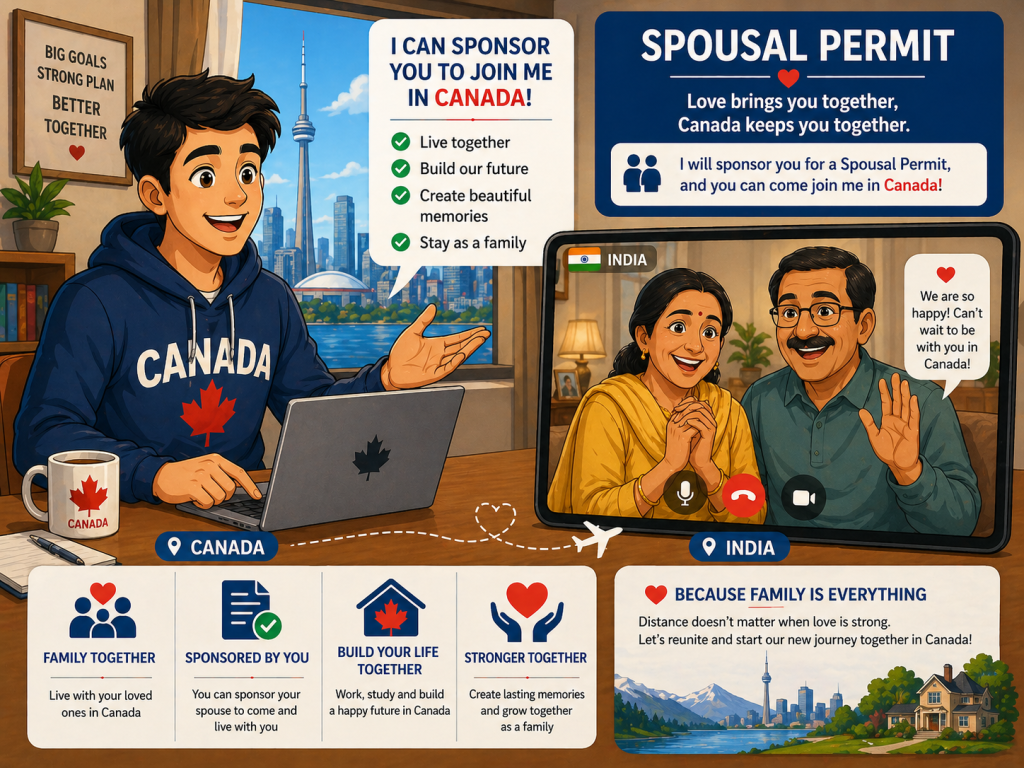
Spousal sponsorship is by far the most frequently used family reunification pathway. If your spouse or partner is a Canadian citizen or permanent resident, they can sponsor you for Canadian PR. The sponsored spouse typically receives an Open Work Permit during the processing period, allowing them to work in Canada while waiting for PR approval.
There are two main pathways:
- Inland Sponsorship: If you are already living in Canada (e.g., on a visitor or student visa), you can apply from within Canada. You may be eligible to receive an open work permit while your application is processed.
- Outland Sponsorship: If you are outside Canada, your sponsor applies from Canada while your application is processed at a visa office in your home country.
Parents and Grandparents Program (PGP)
The PGP allows Canadian citizens and PRs to sponsor their parents and grandparents for permanent residency. Due to high demand, IRCC uses a random draw (lottery) system to select eligible sponsors each year. Spots are limited, so it’s important to submit an interest to sponsor form as soon as the intake opens each year.
In the meantime, parents and grandparents can visit Canada on a Super Visa, which allows stays of up to 5 years at a time (recently extended from 2 years) without needing to renew their status.
Key Documents Required
- Proof of relationship (marriage certificate, photos, communication history)
- Proof of sponsor’s Canadian citizenship or PR status
- Sponsor’s financial documents (proof of income — MNI requirements)
- Completed sponsorship and permanent residence application forms
- Police clearance certificates
- Medical exam results
- Biometrics
Processing Time & Fees
Spousal sponsorship processing times are currently approximately 12 months for most applications. The government fees include a sponsorship fee of CAD $75, an application fee of CAD $490, and a Right of Permanent Residence Fee (RPRF) of CAD $515 — totalling around CAD $1,080 per applicant.
Pro Tip
Genuine relationships are key. IRCC officers are trained to detect marriages of convenience. Include a strong mix of evidence: photos together over time, communication logs, joint finances, travel history together, and statutory declarations from people who know you as a couple.
Quick Comparison Table: Canada Visa Types at a Glance
| Visa Type | Purpose | Max Stay | Work Allowed? | Leads to PR? |
|---|---|---|---|---|
| Tourist Visa (TRV) | Tourism, family visits | 6 months | ❌ No | ❌ No |
| Study Permit | Full-time education | Length of program | ✅ Part-time | ✅ Via PGWP |
| Work Permit | Employment in Canada | Varies | ✅ Yes | ✅ Via Express Entry / PNP |
| Family Sponsorship | Reuniting with family | Permanent | ✅ Yes (open WP) | ✅ Direct PR pathway |
How Language Proficiency Affects Your Canadian Visa
Regardless of which visa type you’re applying for, English (or French) language skills play a huge role in your Canadian immigration journey. Here’s how:
- Study Permit: Requires IELTS, TOEFL, Cambridge C2 Proficiency, PTE, or equivalent
- Express Entry (Work): Language score contributes significantly to your CRS points. A higher IELTS score can earn you up to 160 additional CRS points
- Family Sponsorship: The sponsor doesn’t need language proof, but the sponsored person may need to demonstrate language ability depending on the pathway
- Citizenship: To become a Canadian citizen, you must demonstrate proficiency in English or French (CLB 4 or higher)
This is why investing in language preparation — whether that’s an IELTS prep course, a Cambridge C2 exam, or English fluency coaching — is one of the smartest moves you can make before starting your Canadian immigration journey.
Frequently Asked Questions (FAQs)
Q: Can I apply for a Canadian visa from Pakistan or India? Yes. Canadian visa applications can be submitted online through the IRCC portal from anywhere in the world, including Pakistan, India, Bangladesh, Nigeria, and the Philippines.
Q: How long does it take to get Canadian PR? It depends on the pathway. Express Entry can take as little as 6 months. Provincial Nominee Programs typically take 12 to 18 months. Family sponsorship takes around 12 months for spouses.
Q: Is Canada still accepting immigrants in 2026? Yes. Canada’s immigration targets remain ambitious. The government continues to welcome hundreds of thousands of newcomers annually across all visa categories.
Q: What is the easiest way to immigrate to Canada? There is no single “easiest” path — it depends on your profile. Students with strong academic records benefit from the Study Permit + PGWP route. Skilled workers with high CRS scores benefit from Express Entry. Those with family in Canada should explore sponsorship.
Q: Do I need a language test for a Canadian tourist visa? No. Language tests are not required for tourist visa applications. However, demonstrating basic communication ability during a border interview can be helpful.
Final Thoughts: Your Canadian Dream Is Closer Than You Think
Canada isn’t just a destination — it’s an opportunity. Whether you want to study at a world-class university, build a rewarding career, bring your family together, or simply experience one of the most beautiful and welcoming countries on earth, there is a visa pathway designed exactly for your situation.
The key is understanding your options, preparing your application carefully, and ensuring your language skills are at the level required to open every door Canada has to offer.
At C2 Prep, we help you build the English language skills and immigration knowledge you need to make your Canadian dream a reality. From IELTS preparation to C2 Proficiency coaching and immigration guides — we’ve got you covered every step of the way.
By Prince Kumar, Office Assistant, C2 Prep