We Analysed 100 IELTS Students—Here’s What We Found
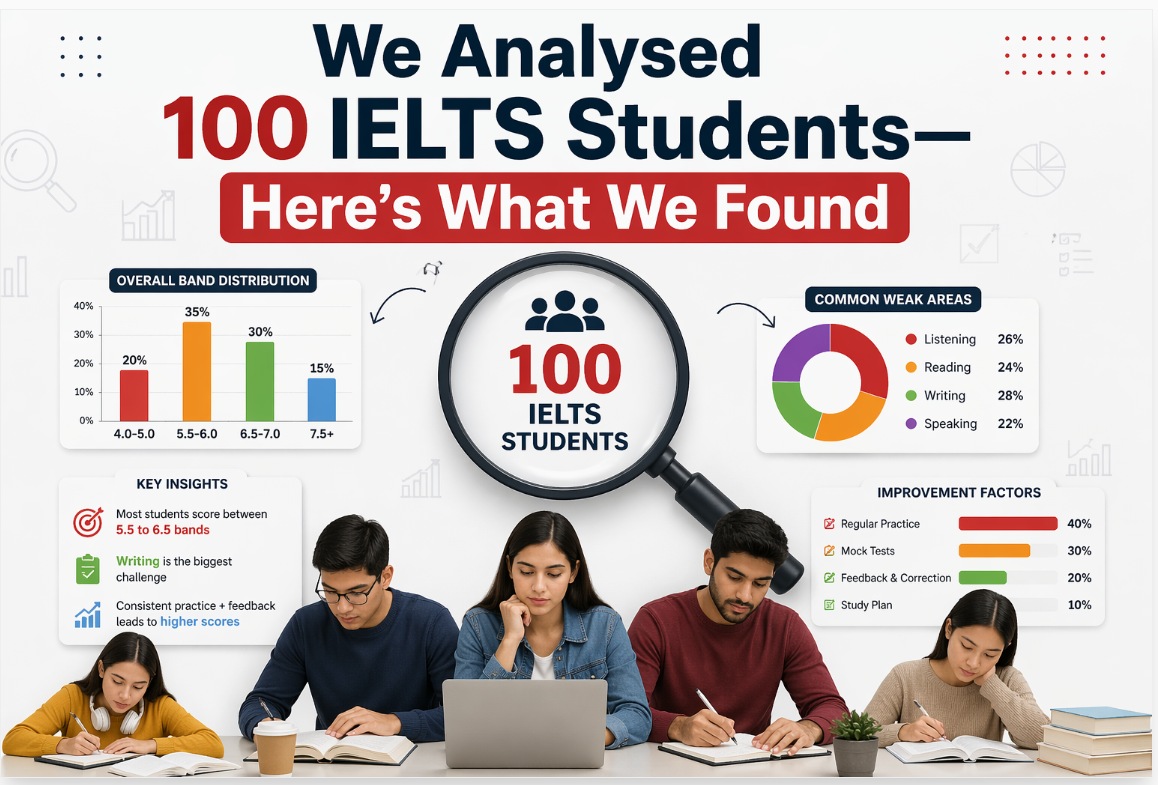
What separates IELTS success from failure? Is it natural talent? The number of hours spent buried in textbooks? The most expensive preparation course money can buy? We decided to stop speculating and start looking at real evidence. Over several months, we closely tracked and analysed 100 IELTS students from start to finish — their daily study habits, preparation strategies, mindset going into the exam, the mistakes they made along the way, and ultimately their final band scores. What we uncovered was eye-opening, occasionally shocking, and in many cases directly contradicted the most popular advice circulating in IELTS preparation communities online. If you are currently preparing for IELTS — whether for the first time or as a retake — what you are about to read could genuinely change your outcome.
Who Were These 100 Students?
Let us start by being completely transparent about who these students actually were, because context matters. This was not a carefully selected group of high-achieving language learners designed to make the results look impressive. These were ordinary, real-world people with full lives, work commitments, family responsibilities, and all the pressures that come with modern life. The group was intentionally diverse.
Among the 100 students we followed, there were:
- Engineers and IT professionals preparing to work abroad
- Nurses and healthcare workers seeking registration in English-speaking countries
- University graduates applying for postgraduate programmes in the UK, Canada, and Australia
- Teachers, accountants, and business professionals pursuing immigration visas
- Homemakers returning to education or relocating with their families
- First-time test takers as well as students retaking the exam after a previous attempt
Their target band scores ranged from 6.0 at the lower end all the way to 8.5 for those applying to highly competitive academic programmes. Some needed only a small improvement of half a band. Others were starting from a significantly lower baseline and needed to climb multiple bands within a limited timeframe. What every single one of them shared was a deeply personal reason for needing to pass — a dream, a deadline, and a life waiting on the other side of that result. That made their journeys worth following closely and their outcomes worth studying carefully.
The Overall Picture — What the Numbers Revealed
Before we go skill by skill, let us look at the headline statistics because they set the stage for everything that follows. Of the 100 students we tracked, only 43 achieved their target band score on their first attempt. That means 57 students — more than half — walked away from their exam disappointed despite having invested significant time, money, and emotional energy into their preparation. Those numbers are sobering. But here is the part that matters most: when we examined the data carefully, the gap between the students who succeeded and those who did not had almost nothing to do with raw language ability or intelligence. The differences came down to strategy, habit, consistency, and mindset — every single one of which is completely within your control.
Here is a quick summary of what the overall data showed:
- 43% of students hit their target band score on the first attempt
- 57% fell short, with Writing being the most common weak point
- Students with structured study plans outperformed unstructured studiers by a wide margin
- Regular feedback was the single biggest accelerator of improvement
- Speaking anxiety affected over 80% of students who underperformed in that section
- Students who practised under timed exam conditions from the start scored significantly higher
Now let us break down exactly what we found, skill by skill and habit by habit.
Most Students Underestimate Writing — And It Costs Them Everything
If there is one single finding from this entire analysis that you take away and act on immediately, let it be this: Writing is where IELTS scores go to die. Of the 57 students who failed to reach their target band, a staggering 67% were held back specifically because of their Writing scores. Not Listening. Not Reading. Not even Speaking. Writing. And what made this finding even more striking was that most of these students knew they needed to work on Writing. They just were not working on it in the right way.
Here is what the students who struggled with Writing were doing wrong:
- Spending most of their time on grammar exercises rather than actual essay writing
- Memorising sample essay templates and trying to force them onto every question
- Focusing almost entirely on vocabulary and sentence structure while ignoring task response
- Never writing under timed conditions until the week before their exam
- Not getting their essays reviewed by anyone qualified to give meaningful feedback
- Repeating the same structural and logical mistakes without ever being told about them
The IELTS Writing section is assessed on four specific criteria: Task Achievement, Coherence and Cohesion, Lexical Resource, and Grammatical Range and Accuracy. Most students preparing independently focus almost exclusively on the last two — vocabulary and grammar — while almost completely neglecting the first two. Task Achievement alone, which evaluates whether you have genuinely and fully answered the question being asked, was the single greatest source of lost marks across our entire sample. Students were writing technically impressive essays that simply did not address the question properly. And because nobody was reviewing their work critically, they had no idea this was happening.
The students in our sample who improved their Writing scores most dramatically shared a very specific set of behaviours. They wrote at least one timed essay every single day. They reviewed their work against the official IELTS band descriptors after every practice session. They sought expert feedback at least once a week and acted on that feedback before their next practice essay. They studied high-scoring sample answers not to copy them but to understand the logic, structure, and language choices behind them. Within three to four weeks of adopting this approach, the average Writing score improvement in this group was half a band — which is often the difference between getting your visa approved or starting the whole process again.
Listening Improved Fastest — But Only With the Right Approach
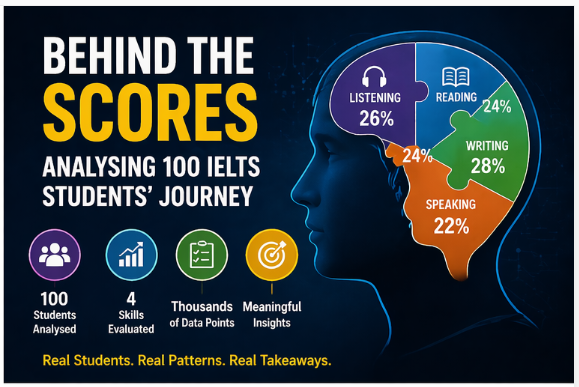
Here is some genuinely good news buried in the data. Among all four IELTS skills, Listening showed the fastest and most consistent rate of improvement across our sample. Students who committed to structured, daily Listening practice using authentic IELTS materials improved their scores by between 0.5 and 1.0 full band within just four weeks. In the context of IELTS, that kind of improvement in that timeframe is remarkable.
But the method of practice made an enormous difference. Here is what actually worked versus what did not:
What worked:
- Completing full IELTS Listening tests under strict timed conditions
- Checking answers immediately after each test
- Re-listening to every single question answered incorrectly
- Identifying the specific reason for each wrong answer — mishearing, distraction, unfamiliar accent, paraphrasing not recognised
- Keeping an error log and reviewing it weekly to spot recurring patterns
- Practising with a wide variety of accents including British, Australian, American, and Canadian
What did not work:
- Listening to English podcasts or music passively in the background
- Watching English-language television with subtitles and counting it as study
- Completing practice tests without reviewing wrong answers in detail
- Focusing only on one type of accent and ignoring others
- Doing Listening practice only occasionally rather than daily
The single most important word in effective Listening preparation is analysis. Every wrong answer is a piece of information. It tells you something specific about where your comprehension breaks down. Students who treated wrong answers as data points to investigate consistently outperformed students who simply moved on to the next practice test after checking their score. If you are currently practising Listening without deeply reviewing your mistakes, you are wasting a significant portion of your preparation time.
Reading Is a Race Against the Clock — Not Just a Test of Comprehension
One of the most persistent and damaging myths in IELTS preparation is the belief that strong general English reading ability will automatically translate into a strong IELTS Reading score. Our data dismantled this myth entirely. A notable number of students in our sample were genuinely proficient English readers in their daily lives — they read English articles, reports, and books regularly — and yet they consistently underperformed in the IELTS Reading section. The reason, in almost every case, was time management.
The IELTS Academic Reading test requires you to answer 40 questions across three long, complex passages in exactly 60 minutes. That is an average of 90 seconds per question. For students who approach the reading the way they would read a newspaper or a novel — starting from the first word and reading carefully through to the last — the clock becomes the enemy. They run out of time. They rush the final passage. They make careless errors on questions they could have answered correctly with more time.
The key skills that separated high scorers from low scorers in Reading were:
- Skimming passages quickly to get the overall structure and main idea before reading in detail
- Scanning for specific information rather than reading every word of every line
- Understanding question types and knowing which strategies work best for each
- Identifying paraphrasing — recognising when the answer in the text is expressed differently from the question
- Managing time deliberately, allocating no more than 20 minutes per passage
- Not wasting time on difficult questions — moving on and returning later if time allows
Students who began practising with a timer from the very first week of preparation performed significantly better on exam day than students who added timed conditions only in the final days before sitting. This is not a skill you can develop overnight. Your brain needs weeks of consistent practice to adapt to the pace and pressure of IELTS Reading. Start timed practice today, not next week.
Speaking Anxiety Was the Biggest Hidden Problem

This finding was perhaps the most human and emotionally resonant discovery of our entire analysis. Among the students who scored below their target band in Speaking, 82% identified anxiety and nervousness as their primary barrier — not insufficient vocabulary, not grammar weaknesses, not pronunciation difficulties. The language was there. The confidence was not.
These students could hold conversations in English perfectly well in relaxed, everyday settings. They chatted comfortably with colleagues, consumed English media without difficulty, and could express themselves clearly when the pressure was off. But the moment they sat across from an IELTS examiner, something shifted. Their mind went blank. Their sentences became hesitant and fragmented. Their fluency evaporated. And their scores reflected that, even though their actual English ability deserved better.
Here is what distinguished the students who overcame Speaking anxiety from those who did not:
- They spoke English out loud every single day without exception — not just on study days
- They recorded their spoken responses using their phone and listened back critically
- They practised answering Part 2 long-turn questions with a timer running
- They expanded their comfort zone gradually by speaking on topics that felt unfamiliar or difficult
- They joined speaking practice groups or worked with a partner to simulate exam conditions
- They focused on fluency and communication first, accuracy second — which is exactly how examiners approach scoring
The students who performed best in Speaking on exam day were not necessarily the most talented English speakers in the group. They were the most experienced at performing under pressure. They had desensitised themselves to the discomfort of speaking formally in English by doing it repeatedly, consistently, and with honest self-review. Recording yourself feels awkward and uncomfortable at first. Almost every student who tried it said the same thing. Do it anyway. Within two weeks, most students reported feeling noticeably more comfortable and natural when speaking, and their scores reflected that shift.
Vocabulary Was Being Learned in the Least Effective Way Possible
Ask the average IELTS student how they build vocabulary and the answer is almost always the same: word lists. They download spreadsheets of academic vocabulary, flashcard apps full of advanced synonyms, and curated lists of impressive-sounding words that they attempt to memorise and insert into their Writing and Speaking. Our data showed that this approach not only failed to improve scores — in many cases it actively made them worse.
Here is what we found about vocabulary learning across our sample:
Students who relied on word lists:
- Often used memorised words incorrectly or in inappropriate contexts
- Produced Writing that felt unnatural and forced — something examiners are specifically trained to identify
- Struggled to use their memorised vocabulary flexibly across different question types
- Had smaller overall vocabulary ranges despite spending significant time on memorisation
Students who built vocabulary through extensive reading:
- Used language more naturally and accurately across both Writing and Speaking
- Demonstrated a wider range of vocabulary at a mid-to-high level used correctly
- Were better able to paraphrase — a critical skill in both Reading and Writing
- Scored consistently higher in the Lexical Resource criterion
The students who performed best in vocabulary-related assessment were readers. They read English-language news articles, opinion columns, academic blogs, and essays on a wide range of topics. They did not just read for comprehension — they noticed interesting words and phrases, looked them up when necessary, and most importantly, saw how language was used naturally in real context. This kind of organic vocabulary acquisition is slower in the early stages but dramatically more effective when it comes to actual exam performance. Stop memorising lists. Start reading.
Finding #6: Feedback Was the Single Biggest Accelerator of Improvement
If there is one investment you can make in your IELTS preparation that will give you the highest return, it is getting regular, qualified feedback on your Writing and Speaking. This was one of the most statistically robust findings in our entire dataset. Students who received consistent expert feedback — at minimum once per week — improved at approximately twice the rate of students who self-studied exclusively, regardless of their starting band score.
The reason is logical once you think about it clearly. Without feedback, you are operating blind. You cannot see your own blind spots. You might be making the same Task 2 structural error in essay after essay for six weeks, reinforcing it each time, without any awareness that it is happening. You might be consistently misusing a particular grammatical structure in your Speaking and training yourself to repeat that mistake daily. Feedback interrupts this cycle. It holds up a mirror and says: here is exactly where you are losing marks, and here is specifically what you need to do differently.
Here is what effective feedback looks like in practice:
- Written feedback on Task 1 and Task 2 essays against each of the four assessment criteria
- Specific identification of grammatical errors with explanations of why they are wrong
- Vocabulary suggestions that fit naturally within the context of your writing
- Speaking feedback that addresses fluency, coherence, vocabulary range, and pronunciation separately
- Actionable guidance — not just what is wrong, but what to do about it
- Regular frequency — weekly at minimum, more often if possible
Private IELTS tutors offer the most personalised version of this feedback, but they are not the only option. Online writing correction platforms, IELTS preparation communities, speaking exchange partners, and structured online courses with human feedback components can all serve this function. The delivery method matters far less than the consistency. Find a feedback mechanism that works for your budget and schedule, and use it every single week without fail.
A Focused 4-Week Plan Demolished 6 Months of Unstructured Study
This finding consistently surprises people when we share it, but the evidence is clear and consistent. Students who followed a tightly structured, goal-driven 4-week preparation plan outperformed students who had been studying for three, four, five, or even six months without a defined structure. Longer preparation time, without intentional structure, does not produce better results. In fact, it often produces worse ones.
Here is why long, unstructured study periods fail so many IELTS candidates:
- Without daily targets, students naturally gravitate toward what they already do well
- Weak skills are avoided because they feel uncomfortable and discouraging
- There is no mechanism for tracking progress, so students cannot tell if they are improving
- Motivation fluctuates wildly over long periods without clear milestones
- Burnout and study fatigue set in, leading to reduced quality of practice over time
- False confidence builds up because students feel like they are preparing without measuring whether the preparation is working
In contrast, here is what a structured 4-week plan looked like for the students in our sample who succeeded:
- Week 1: Diagnostic assessment of all four skills, identification of weakest areas, daily skill-specific practice with timed conditions
- Week 2: Intensive focus on weakest skill, continued maintenance of stronger skills, first full mock exam with detailed review
- Week 3: Targeted practice on identified error patterns from mock exam, vocabulary and grammar consolidation, second full mock exam
- Week 4: Full exam simulations, light review of all skills, mindset and logistics preparation for exam day
Students following this kind of framework knew exactly what they were doing each day, could measure their progress week by week, and arrived at their exam feeling prepared and focused rather than vaguely hoping that enough time had passed to make a difference. If you do not currently have a structured plan, creating one is the single most impactful thing you can do right now.
Exam Simulation Made a Dramatic Difference on the Day

One finding that emerged unexpectedly but proved consistently significant was the impact of full exam simulation on actual exam day performance. Students who had completed at least two full mock exams — sitting for the complete duration of all sections, under real exam conditions, without pausing — performed noticeably better on the actual day compared to students who had only ever practised individual sections in short, pressure-free bursts.
The reasons are both psychological and practical:
- Full simulation familiarises students with the physical and mental stamina required
- It eliminates surprises on exam day — the format, timing, and pressure feel familiar
- It reveals time management weaknesses that never appear in short practice sessions
- It builds the mental endurance needed to maintain concentration across multiple hours
- It gives students a realistic benchmark of their current performance level
- It reduces exam day anxiety because the experience no longer feels completely unknown
Students who sat their exam having only ever practised in short, comfortable, self-paced sessions were frequently caught off guard by the sheer intensity and duration of the real test. The language skills were there, but the stamina and composure were not. Treat your mock exams as seriously as the real thing. Sit in a quiet room. Follow every timing rule. Do not pause, check your phone, or take unscheduled breaks. The more real your practice feels, the more natural the real exam will feel.
The Students Who Succeeded Thought About IELTS Differently
Beyond the specific skill-based findings, one of the most compelling patterns we observed was a fundamental difference in mindset between the students who hit their target and those who did not. It was not dramatic or obvious. It showed up in small, consistent ways throughout their preparation.
Students who succeeded tended to:
- View mistakes as useful information rather than evidence of failure
- Approach unfamiliar question types with curiosity rather than panic
- Focus on what they could control rather than worrying about exam conditions
- Build English into their daily life beyond their formal study sessions
- Stay consistent on difficult days rather than only studying when they felt motivated
- Trust the process even when improvement felt slow or invisible
Students who struggled tended to:
- Avoid their weakest areas because practising them felt discouraging
- Chase shortcuts — memorised templates, prediction lists, miracle techniques
- Study in intense bursts followed by long periods of inactivity
- Measure success by time spent rather than quality of practice
- Become paralysed by anxiety rather than channelling it into focused preparation
Mindset is not a soft, abstract concept in the context of IELTS preparation. It is a practical, measurable factor that shows up directly in the quality of your practice and ultimately in your score. The belief that you can improve — combined with the willingness to do the uncomfortable work of addressing your weaknesses — is not just motivational advice. It is a strategy.
What the Top Scorers All Had in Common
When we looked specifically at the students who not only hit their target band but exceeded it — particularly those aiming for Band 7.0 and above — a very clear set of shared characteristics emerged. These were not exceptional people. They were consistent ones.
Every high scorer in our sample shared these habits:
- They practised all four skills every single day, even if only briefly
- They wrote at least one timed essay per day and had it reviewed regularly
- They did active, analytical Listening practice rather than passive exposure
- They read extensively in English outside of their IELTS study materials
- They recorded their Speaking practice and listened back critically
- They maintained an error log and reviewed it weekly
- They took at least two complete mock exams under real conditions
- They got expert feedback on Writing and Speaking consistently
- They followed a structured plan with daily and weekly targets
- They addressed their weakest areas first rather than avoiding them
None of these habits require exceptional intelligence, unlimited time, or an expensive coaching programme. Every single one of them is available to you starting from today. The question is not whether you are capable. The question is whether you are willing to be consistent.
What This All Means For You
The data from 100 real students delivers a clear and unambiguous message. IELTS is not a test of raw intelligence or natural language talent. It is a test of preparation quality, strategic thinking, and consistent effort applied in the right direction. The majority of students who fall short do so not because they lack the ability to succeed but because they prepare in ways that simply do not match what the exam is actually measuring and rewarding.
You now have access to the patterns that separate the students who succeed from the students who do not. You know which skills are most likely to hold your score back. You know what kinds of practice actually move the needle and what kinds waste your time. You know the habits of students who exceed their targets and the pitfalls that trap the students who fall short. The information is in front of you. What happens next is entirely up to you.
Here is your action plan, drawn directly from the data:
- Start with a full diagnostic mock exam to identify your current level across all four skills
- Prioritise Writing Task 2 — commit to daily timed essays and weekly expert feedback
- Do structured, analytical Listening practice every day using real IELTS materials
- Build Reading speed through timed practice from day one — not the week before your exam
- Record your Speaking every day, listen back, and practise until the discomfort fades
- Build vocabulary through reading widely in English — not through memorising word lists
- Get qualified feedback on your Writing and Speaking at least once every week
- Follow a structured 4-week preparation plan with clear daily and weekly goals
- Complete at least two full mock exams under strict, real exam conditions
- Approach your weaknesses with curiosity rather than avoidance
Final Thought
We analysed 100 students so that you do not have to begin your preparation from zero. The patterns we found are real, consistent, and repeatable. The mistakes are predictable and, more importantly, preventable. The path to your target band score is not as mysterious or as difficult as it might currently feel. It requires the right strategy, the right habits, and the willingness to do the work that most students are not disciplined enough to do consistently.
Thousands of people sit IELTS every single month believing that studying harder is the answer. The data says otherwise. Studying harder without studying smarter is one of the most exhausting and demoralising experiences an IELTS candidate can have. But studying smart — with structure, feedback, consistency, and honest self-awareness — transforms the entire journey. It makes progress visible. It makes the exam feel manageable. And it makes your target score feel not like a distant hope but like an inevitable outcome of the work you are putting in every day.
Your target score is not out of reach. It never was. Now you know exactly what to do to get there. Go and get it.
By :- Sarthak Tiwari, Office Assistant, C2 Prep..