IELTS Speaking Part 2: How to Talk for 2 Minutes Without Stopping
That Dreaded Moment of Silence
You pick up the cue card. You read it. You think — okay, I know this topic. The examiner says “begin.” And then… your mind goes blank after 45 seconds and you’re sitting there, desperately searching for something — anything — to say.
If this sounds familiar, you are absolutely not alone. IELTS Speaking Part 2, also called the Long Turn, is the part that trips up even confident English speakers. The pressure of speaking uninterrupted for a full two minutes feels completely unnatural — because in real life, nobody does that.
But here’s the good news: this is a completely learnable skill. It’s not about how much English you know. It’s about having the right strategy. And that’s exactly what this blog is going to give you.
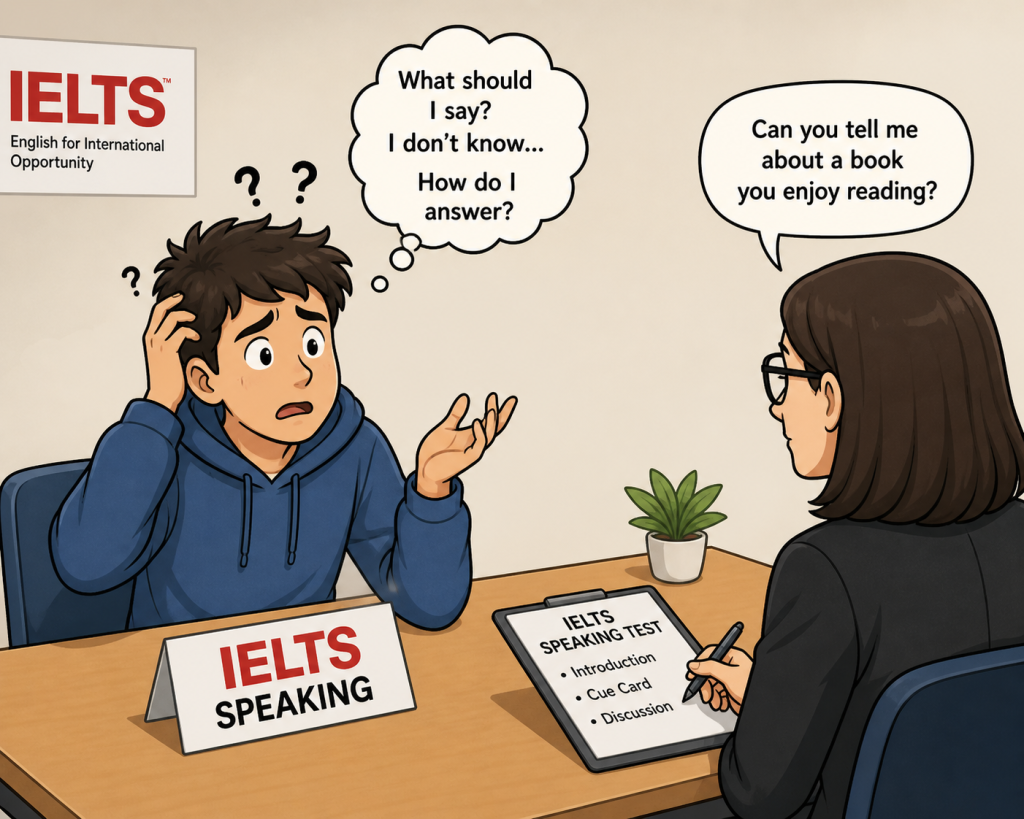
First — What Exactly Is IELTS Speaking Part 2?
IELTS Speaking has three parts. Part 2 is the middle section where the examiner hands you a cue card — a small card with a topic and 3–4 bullet points guiding what to talk about.
You get 1 minute to prepare and make notes. Then you speak for 1 to 2 minutes. The examiner will stop you at 2 minutes if you haven’t already finished. After that, they may ask 1–2 short follow-up questions.
Typical cue card topics include things like:
- Describe a person who has influenced you
- Describe a place you would like to visit
- Describe a time you achieved something difficult
- Describe a book, film, or piece of music you enjoyed
The topics are always personal and conversational — they’re not testing your knowledge of world events or complex academic ideas. They want to hear you speak naturally and at length.
Why Do Students Run Out of Things to Say?
Before we fix the problem, let’s understand it. There are three main reasons students struggle:
1. They answer the question too directly. They say what needs to be said in 30 seconds and then have nothing left. The cue card says “describe a place you’d like to visit” — they say “I want to visit Paris because it’s beautiful and has good food.” Done. 40 seconds gone.
2. They don’t use their 1-minute preparation time well. Most students just re-read the card during prep time instead of actually planning what they’re going to say.
3. They panic when they slow down. A brief pause feels like an eternity under exam pressure, so students rush and then finish early.
The IELTS Part 2 Framework That Actually Works
Here’s a simple structure you can apply to almost any cue card topic. Think of your 2 minutes as having 4 sections, each lasting around 25–30 seconds.
Section 1 — Introduce and Set the Scene (25–30 seconds)
Start by directly addressing the topic and painting a picture. Give context. Who, what, where, when.
“The place I’d like to talk about is Kyoto in Japan. I first heard about it from a documentary I watched about two years ago, and ever since then it’s been at the top of my travel wish list. Kyoto is a city in western Japan known for its ancient temples, traditional tea houses, and stunning cherry blossom season…”
See how that naturally fills time? You haven’t even gotten to the “why” yet.
Section 2 — Go Deeper Into the Details (25–30 seconds)
Now talk about the specific aspects mentioned on the cue card. Use the bullet points as your guide but don’t just answer them mechanically — expand on each one.
“One of the main reasons I want to visit is the cultural history. Unlike Tokyo, which is very modern and fast-paced, Kyoto still feels deeply rooted in traditional Japanese culture. I’d love to walk through the Arashiyama bamboo grove, visit the Fushimi Inari shrine with its thousands of red torii gates, and experience a proper Japanese tea ceremony…”
Section 3 — Add Personal Connection or Feeling (20–25 seconds)
This is where many students miss out on marks. Examiners love when you express feelings, opinions, and personal reactions. It sounds natural and shows range.
“What really draws me to Kyoto is the sense of calm I imagine it has. My life at the moment is quite hectic with studying and work, and the idea of walking through peaceful gardens and ancient temples honestly sounds like the perfect escape. I think travel is most meaningful when a place speaks to something you personally need at that point in your life…”
Section 4 — Wrap Up With a Forward-Looking Statement (15–20 seconds)
End with something that looks ahead — a hope, a plan, or a reflection. This signals to the examiner that you’re wrapping up naturally, not just stopping.
“I genuinely hope I’ll get to visit Kyoto within the next couple of years. I’ve already started looking into the best time to go — apparently late March to early April for the cherry blossoms is absolutely magical. It’s one of those places I feel like I’d never want to leave.”
That’s your 2 minutes — structured, natural, and full.
How to Use Your 1-Minute Prep Time (Most Students Waste It)
Your preparation minute is pure gold. Here’s how to spend it:
- Write 4–5 keywords, one for each section of your talk — not full sentences
- Pick a specific memory or example to anchor your talk — vague answers run dry fast, specific stories don’t
- Decide your opening line — knowing exactly how you’ll start removes the biggest source of panic
- Note one personal feeling or opinion you’ll include — this adds natural depth
For example, for a cue card about a person who inspired you, your notes might look like:
Uncle Tariq — engineer — childhood visits to his office — showed me hard work pays off — still message him for advice — inspires me to keep going with studies
That’s enough to talk for 2 solid minutes.
5 Language Tips to Fill Time Naturally
These phrases are your best friends in Part 2. They sound fluent and they buy you seconds:
- “What I find particularly interesting about this is…”
- “Now that I think about it…”
- “I think what struck me most was…”
- “It’s funny because at the time I didn’t realise how much it would affect me…”
- “To give you a bit of background…”
These transitions keep your speech flowing and give your brain a moment to catch up without silence.
One Honest Piece of Advice
Practice out loud — not in your head. Most students “prepare” by imagining what they’d say. That is not the same as actually saying it. The physical act of speaking, pausing, choosing words in real time, and keeping your voice steady is a skill that only improves when you physically do it.
Set a timer for 2 minutes. Pick a random topic. Speak. Record yourself. Listen back. You’ll immediately notice where you slow down, where you repeat yourself, and where you genuinely run out of ideas — and that’s exactly where you need to improve.
Do this once a day for two weeks and your Part 2 performance will be unrecognisable.
Final Thought
IELTS Speaking Part 2 rewards preparation and structure, not just language ability. The students who score Band 7 and above aren’t necessarily the ones with the best English — they’re the ones who know how to organise their thoughts quickly and keep talking with confidence.
You already have stories, opinions, and experiences worth sharing. You just need the right framework to let them out.
At C2 Prep, we help IELTS students build exactly these skills — from Speaking Part 2 strategies to full mock test preparation. Whether you’re targeting Canada PR or simply want your best possible score, we’re here to help.
By Prince Kumar, Office Assistant, C2 Prep