CD IELTS vs Paper-Based IELTS: Everything Students Need to Know in 2026
The Ultimate Guide to IELTS Test Formats — and Why the Game Has Changed Forever
Introduction: The End of an Era
For over three decades, millions of students worldwide sat down with a pen, a paper booklet, and a racing heartbeat to take the IELTS exam. That era is now officially over.
From mid-2026, IELTS will no longer be offered as a paper-based test. All IELTS tests will be delivered on computer, with exact timelines varying by market. This is one of the biggest changes in IELTS history — and if you’re planning to take the exam for study, work, or immigration, you need to understand exactly what this means for you. IELTS
This blog breaks down everything: what CD IELTS is, how it compares to paper-based IELTS, the key advantages, and how to prepare smartly for the computer-delivered format.
What Is CD IELTS (Computer-Delivered IELTS)?
CD IELTS, or Computer-Delivered IELTS, is simply the digital version of the same IELTS exam you already know. The Computer-Delivered IELTS allows test-takers to complete the Listening, Reading, and Writing sections on a computer, while the IELTS Speaking test remains face-to-face with a certified examiner. IELTS Material
This is an important point that confuses many students — the Speaking test has NOT changed. You will still sit across from a real human examiner and have a conversation. Only the written and listening components move to the screen.
Why Is IELTS Dropping the Paper Format?
This didn’t happen overnight. Over 80% of IELTS test takers globally had already chosen the computer-based format by 2024, making this official transition the logical endpoint of a shift that began in 2017. Ielts
IELTS found higher satisfaction among test takers who choose IELTS on computer because it is more convenient, results are faster, and it offers One Skill Retake. Security was another major driver. Paper-based testing involves printing, shipping, scoring, storing, and disposing of test booklets which contain sensitive information. A system that delivers test items directly to test takers via a secure network is probably easier to secure both in terms of pre-test access to questions and post-test theft of questions. IELTSThe PIE News
CD IELTS vs Paper-Based IELTS: Head-to-Head Comparison
1. Test Format & Content
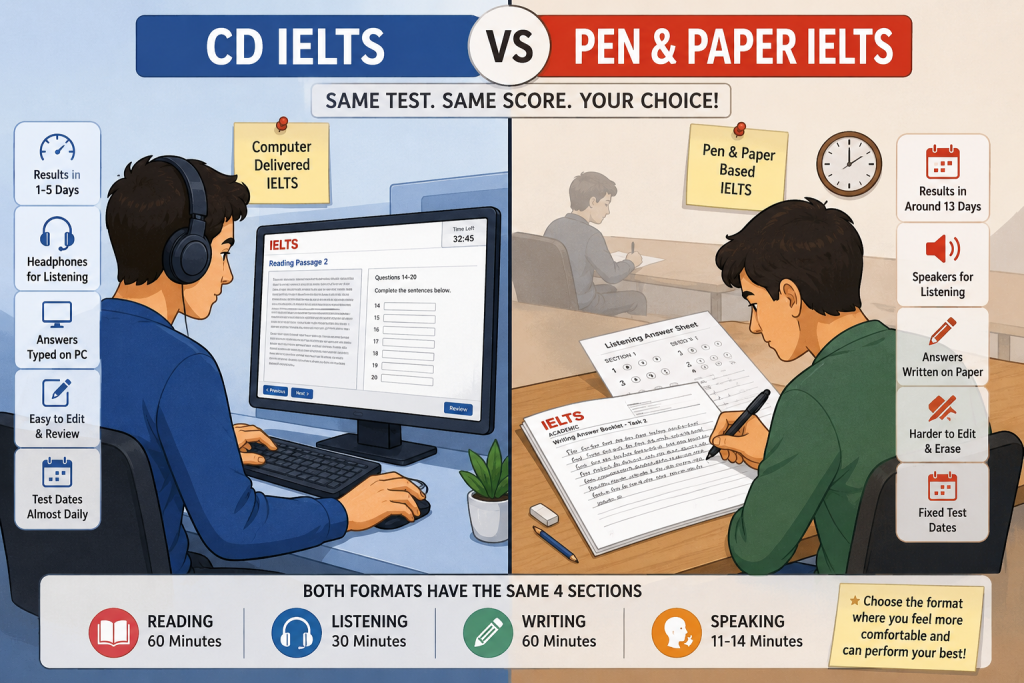
This is where students get unnecessarily worried. The test content, difficulty level, and scoring criteria are identical between computer-delivered and paper-based IELTS. Neither format gives you an advantage in scoring. The difference is purely in how you interact with the test — typing vs handwriting, clicking vs circling, on-screen vs on-paper. IELTS 9
2. Results Turnaround Time
This is one of the biggest practical differences. Computer-delivered IELTS results are available in 3–5 business days. Paper-based results take 13 calendar days. If you’re working with a visa deadline or university application cutoff, this alone can be a game-changer. IELTS 9
3. Test Dates & Availability
In 2025, there are more computer-delivered IELTS test centres than ever before, especially in major cities. With more frequent test dates throughout the month, it’s easier to find a time that works for you. IELTS
4. Writing Section Experience
The computer-delivered IELTS may feel easier than the paper-based IELTS if the test-taker is competent at typing on a keyboard. The main advantage is that candidates can edit their answers much more easily in the Writing section, saving time. Features like automatic word count and the ability to copy-paste or restructure paragraphs give typists a genuine practical edge. IELTS Material
5. Listening Section
In CD IELTS, you listen through headphones and type your answers directly on the screen. This eliminates the risk of messy handwriting or transcription errors — one less thing to worry about under pressure.
6. One Skill Retake (OSR) — CD IELTS Exclusive
This is arguably the most significant advantage of CD IELTS. The IELTS One Skill Retake (OSR) is available only for Computer-Delivered IELTS — not for paper-based IELTS. If you took a CD-IELTS test and scored well in three sections but fell short in one, you can retake that single section within 60 days of your original test. Your final score report will combine the three original section scores with the new retaken section score, producing a single composite Test Report Form (TRF) that is treated as a complete, valid IELTS result. EEC
For example: if you scored Listening 7.5, Reading 7.0, Speaking 7.0 but Writing 6.0 — and you need 7.0 in all bands for your university — you only retake Writing. You don’t risk your other three scores. The IELTS One Skill Retake needs to be booked within 60 days of your original test date. Kanan
The New “Writing on Paper” Hybrid Option
IELTS has acknowledged that some students genuinely prefer handwriting their essays. In selected markets, IELTS will introduce a “Writing on Paper” option. This update will allow test takers to personalise their test experience by handwriting their answers to the Writing component on paper if they choose. Importantly, this update does not change the IELTS skills assessed, the test construct, or the way results should be interpreted by institutions. IELTS
The specific markets receiving the Writing on Paper option had not been officially announced as of March 2026, though industry analysts expect India and China to be likely candidates given the high popularity of paper-based testing in those countries. One important caveat: the UKVI track is not eligible for the Writing on Paper option due to UK Home Office security requirements. IeltsIelts
Scoring: Is CD IELTS Harder or Easier?
This is the most common question students ask — and the answer is clear. Scores from the computer-based IELTS are confirmed to be fully comparable to paper-based results, meaning no candidate is disadvantaged by the format shift. CIC TIMES
That said, your personal experience may differ based on your skills. EEC data from 2024–2026 shows that students who take CD IELTS score an average of 0.3–0.5 bands higher in Writing compared to their paper-based mock tests. The combination of typing speed, real-time word count, and copy-paste functionality gives a measurable boost — especially for students targeting Band 6.5–7.5. EEC
Who Benefits Most from CD IELTS?
CD IELTS is the better choice for the majority of test-takers. Regular computer users — people who type emails, use social media, write documents, or work on a computer daily — will find CD IELTS natural. Students needing OSR eligibility should also choose CD IELTS, as One Skill Retake is not available for paper-based IELTS under any circumstance. EEC
If you’re a slow typist or someone who thinks better with a pen in hand, the “Writing on Paper” hybrid option (where available) might suit you well.
How to Prepare for CD IELTS: 7 Smart Tips
- Practice on the official interface. The IELTS website offers free practice tests in the computer-delivered format. Use them from day one so the interface feels familiar on exam day.
- Build your typing speed. If you type fewer than 40 words per minute, invest time in this. Websites like TypingClub or Keybr can help. Aim for at least 50–60 wpm for comfortable Writing performance.
- Get used to reading on screen. Many students find screen reading tiring. Practice reading long articles, essays, and academic texts on your laptop or desktop — not your phone.
- Use headphones while practising Listening. In CD IELTS, you’ll hear audio through headphones. Practise this way to simulate the actual test environment.
- Master the word count feature. CD IELTS shows a real-time word count for Writing. Learn to use it strategically so you never fall below the minimum word requirement.
- Plan for One Skill Retake. Know your weakest skill before the exam. If you miss your target band in just one area, OSR gives you a safety net — but only if you’ve taken CD IELTS.
- Simulate full tests on a computer. Don’t practice on paper and then switch to computer on exam day. Your entire preparation should mirror the actual test experience.
Key Dates to Know
- Mid-2026: Paper-based IELTS officially discontinued globally
- June 27, 2026: Final date for paper-based testing in most markets
- Within 60 days of original test: Deadline to book One Skill Retake
Frequently Asked Questions
Q: Is CD IELTS accepted by all universities and immigration authorities? Yes. CD IELTS results carry the same validity and are accepted by all institutions that accept standard IELTS, including universities, immigration bodies (Australia, Canada, UK, New Zealand), and professional organizations.
Q: Does the Speaking test change in CD IELTS? No. The Speaking test remains a face-to-face interview with a certified human examiner. This is unchanged.
Q: Can I still take IELTS on paper in 2026? Only until June 27, 2026, in most markets. After that, all tests will be computer-delivered.
Q: Is CD IELTS more expensive than paper-based IELTS? No. The test fee is the same for both formats.
Final Verdict: Should You Be Worried?
Not at all. The shift to CD IELTS is ultimately good news for students. Faster results, more test dates, exclusive access to One Skill Retake, and a more comfortable editing experience in Writing are all genuine improvements. The content of the exam — what it tests and how it scores you — remains exactly the same.
The students who will thrive are those who prepare smartly: practice on the digital interface, build their typing confidence, and use every tool the format offers. The format has changed. The opportunity hasn’t.