Why Self-Study Fails for CLB 9+ (And What Actually Works)
Category: CLB 9+ Strategy Tags: CLB 9, Language Assessment, IELTS, CELPIP, Immigration, Study Strategy, Canada PR Read Time: 12–15 minutes Meta Description: You’ve been studying for months — podcasts, grammar drills, vocabulary apps. Yet your CLB score refuses to cross 9. Here’s the uncomfortable truth no one tells you, and the proven system that actually works.
Introduction: The Plateau Nobody Warns You About
You passed CLB 7. Then CLB 8. You celebrated, took a breath, and told yourself CLB 9 was just a matter of time and more study.
That was eight months ago.
Since then you’ve listened to English podcasts on your morning commute. You’ve switched your phone to English. You’ve watched Netflix without subtitles, read Canadian newspapers, practiced speaking with coworkers, and done every grammar exercise you could find online. You’ve spent real money on IELTS prep books, YouTube courses, and language exchange apps.
And your score? Still stuck. Still not a 9.
If this sounds familiar, you are not alone — and more importantly, you are not failing because of a lack of effort or talent. You are failing because the strategy you are using was never designed to get you to CLB 9. It was designed for general fluency improvement, and CLB 9 is an entirely different target.
This blog post is going to tell you the truth about why self-study hits a wall at CLB 9+, what the research actually says about language assessment at advanced levels, and — most importantly — what the learners who do break through are doing differently.
Read this carefully. It might be the most useful hour you spend on your CLB journey.
What CLB 9 Actually Means (Most People Get This Wrong)
Before we talk about why self-study fails, we need to get clear on what CLB 9 actually is — because most people have a fundamentally wrong mental model of it.
CLB stands for Canadian Language Benchmarks. It is the national standard used across Canada to describe the English language proficiency of adult immigrants and newcomers. CLB levels run from 1 to 12, with CLB 9 representing the threshold for what is described as “advanced” professional language use.
Here is what most people think CLB 9 means: it means you speak English very well. Fluently. Like a native speaker or close to it.
That is not what CLB 9 means.
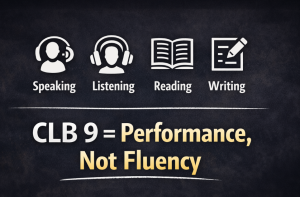
CLB 9 means you can consistently demonstrate precise, purposeful, and organized use of English across four specific skill strands — speaking, listening, reading, and writing — under timed, structured, assessment conditions, according to a specific rubric that trained examiners apply.
The distinction matters enormously.
You can be highly fluent in English and still score CLB 7 or 8 on a formal assessment. Why? Because fluency and assessment performance are two different skills. Fluency is about communication. Assessment performance is about demonstrating specific, rubric-defined competencies in a controlled environment — consistently, under pressure, within time limits.
CLB 9 is not asking “can this person communicate in English?” It is asking something far more precise: “Does this person use English with the accuracy, coherence, range, and task fulfillment of a university-educated professional, in every strand, every time?”
That is a very different bar. And it requires very different preparation.
The 4 Core Reasons Self-Study Fails at CLB 9+
Let’s be specific. Here are the four structural reasons why self-study — no matter how disciplined — almost always fails to push learners past CLB 8.
Reason 1: You Have No Idea What Is Actually Holding You Back
This is the biggest one, and it affects virtually every self-studier.
When you study on your own, you have no reliable way to diagnose your actual weaknesses. You have a vague sense of what you’re good at and what you’re not, but that sense is almost always wrong — or at minimum, incomplete.
Here’s why this matters at CLB 9. The benchmark is not an average. You don’t get to be a CLB 10 in reading and a CLB 7 in writing and call yourself a CLB 9. Each strand is assessed independently. If any single strand falls below the threshold — even by the narrowest margin — your overall result stays below CLB 9.
So if you are secretly losing points in writing because your paragraph cohesion doesn’t quite meet the CLB 9 descriptor, but you don’t know that because nobody has ever assessed your writing against the actual CLB rubric, you will keep practicing speaking and reading and wondering why your score won’t move.
This is the diagnostic problem. Self-study cannot solve it. You need a strand-level, rubric-aligned diagnostic assessment conducted by someone who actually knows the CLB benchmarks — not a general sense of “you’re pretty good at English.”
Reason 2: You Are Studying the Wrong Material
Not all English study is CLB study. This seems obvious, but its implications are profound and almost universally ignored by self-studiers.
IELTS preparation materials are calibrated to IELTS rubrics. CELPIP preparation materials are calibrated to CELPIP rubrics. General English courses are calibrated to whatever framework the teacher was trained in. YouTube language channels are calibrated to what gets clicks.
None of these are the same as CLB 9 preparation.
The CLB has specific performance descriptors for each level and each skill area. These descriptors define precisely what a CLB 9 performance looks, sounds, and reads like. They specify what kind of vocabulary range is expected, what grammatical structures are required, how ideas should be organized, what kind of task completion is necessary.
If you are not studying directly against these descriptors — if every practice task you do is not explicitly designed to hit CLB 9 criteria — you are practicing in the dark. You may be improving. But you are improving at the wrong game.
Most self-study material available online is general, not CLB-specific. It was built for the mass market, not for the narrow precision of CLB 9+. Using it to prepare for CLB 9 is like training for a marathon by cycling. You are building fitness, but not the specific fitness the race demands.
Reason 3: Self-Study Keeps You in Your Comfort Zone
Human beings are psychologically wired to practice what they are already good at. It feels productive. It feels rewarding. It generates a sense of progress.
It is also the reason plateaus exist.
When you self-study, you choose your own materials, your own tasks, your own difficulty level. And unconsciously, you almost always choose tasks slightly below your current ceiling — tasks you can do well, tasks that confirm your competence, tasks that don’t make you feel inadequate.
The problem is that improvement happens at the edge of your current ability, not inside your comfort zone. To get better at the things you’re weak at, you need to repeatedly do things you are bad at — awkwardly, frustratingly, unsuccessfully — until you get better. And that is deeply uncomfortable. Self-study has no mechanism to force you into that discomfort. Expert-guided preparation does.
A skilled CLB instructor will identify your weakest areas and direct your practice there, specifically and relentlessly, even when it’s uncomfortable. That targeted discomfort is what closes the gap between CLB 8 and CLB 9.
Reason 4: There Is No Feedback Loop
This is the silent killer of CLB self-study.
You practice writing a task. You finish it. You read it back. It sounds good to you. You move on.
But here’s the issue: you cannot reliably evaluate your own output at the level CLB 9 demands. Your reading of your own writing is filtered through your own linguistic intuitions — the same intuitions that produced the errors in the first place. You will not see what a trained CLB assessor sees.
The same is true of speaking. You cannot hear your own disfluencies the way an examiner does. You cannot identify the specific coherence gaps in your spoken discourse. You cannot objectively evaluate whether your vocabulary range is meeting the CLB 9 threshold or falling just short.
Without feedback from someone who knows exactly what CLB 9 performance looks like — and who can mark up your output and show you precisely where you are losing points — you are flying blind. You may practice for months and reinforce the same errors over and over again, making them more automatic rather than less.
Effective feedback, delivered by an expert, calibrated to the CLB rubric, given on every piece of practice work you produce — that is what separates learners who improve from learners who plateau.
The Research: Why Expert Feedback Changes Everything
The field of applied linguistics has been studying language learning and assessment for decades. The findings are consistent and clear.
Studies on what researchers call “deliberate practice” show that improvement in complex cognitive skills — including language use at advanced levels — requires three things: tasks at the edge of current ability, immediate and specific feedback, and mental engagement with the feedback. Passive exposure, general practice, and repetition without feedback do not reliably produce improvement at advanced levels.
Research on language assessment specifically shows that test performance is a learnable skill, distinct from underlying language competence. Learners who receive explicit instruction and feedback on how assessments are scored consistently outperform equally proficient learners who prepare on their own — not because they know more English, but because they know more about what the assessment rewards.
One landmark study found that learners who received examiner-level feedback on writing samples for eight weeks improved their assessed writing performance by more than a full band level, while a control group who practiced the same amount with no feedback showed no measurable improvement.
Eight weeks versus no improvement. Same amount of practice. The only variable was expert feedback.
This is not surprising to anyone who has ever learned a complex skill — music, surgery, athletics. At the beginner and intermediate level, practice alone produces improvement. At the advanced level, you need a coach, and you need specific feedback on specific errors, applied deliberately over time.
CLB 9 is an advanced level. It requires advanced preparation methods.
What Actually Works: The CLB 9+ Preparation System
So what does effective CLB 9+ preparation actually look like? Here is the system that consistently produces results.
Step 1: Start With a Real Diagnostic Assessment
Before you practice a single task, you need to know where you actually stand — strand by strand, skill by skill, descriptor by descriptor.
A proper CLB diagnostic is not a practice test that gives you a score. It is an assessment that tells you, in precise terms, what you are doing well and what you are not, measured against the actual CLB 9 performance descriptors. It tells you which strand is your weakest, which specific skills within that strand are costing you points, and where to direct your preparation.
Without this, every hour of study is a guess. With this, every hour of study is targeted.
Do not skip the diagnostic. Do not replace it with a general practice test. Do not assume you know your weaknesses. Get the data.
Step 2: Learn the CLB 9 Descriptors Deeply
Most CLB candidates have never read the actual CLB benchmark descriptors. This is a serious mistake.
The Canadian Language Benchmarks document is publicly available. It describes, in specific and measurable terms, what CLB 9 performance looks like across every strand. Read it. Understand it. Internalize what “CLB 9 speaking” means versus “CLB 8 speaking.” Understand what the vocabulary range requirement actually is. Understand what “coherence and cohesion” means at CLB 9 versus CLB 8.
When you understand the rubric, you can begin to evaluate your own practice with much greater accuracy. You stop practicing vaguely and start practicing purposefully. You know what you are aiming for.
Step 3: Work With Expert-Annotated Feedback on Every Task
Every writing and speaking sample you produce should be reviewed by someone who can assess it against CLB 9 rubrics — and annotate it specifically.
“Good job” is not feedback. “Your paragraph lacks a clear topic sentence, which costs you points on coherence — here is what a CLB 9 paragraph structure looks like” is feedback.
The annotation matters as much as the grade. You need to understand, at the level of specific sentences and specific choices, what you did that was below CLB 9 and what you should have done instead. That specificity is what drives improvement.
If you are working with a tutor who cannot provide CLB-rubric-aligned, annotation-level feedback, find a different tutor. General English feedback will not get you to CLB 9.
Step 4: Attack Your Weakest Strand With Disproportionate Focus
Once your diagnostic tells you your weakest strand, spend at least 60% of your practice time there. Not on your strongest strand. Not on the strand you enjoy the most. On the one that is holding your overall score down.
This is psychologically difficult. It feels inefficient because you make slower apparent progress. But it is the only strategy that works.
If writing is your weak strand, write every single day. Write under timed conditions. Write different task types. Have every piece annotated by an expert. Read CLB 9 model texts and analyze exactly what makes them CLB 9. Write again tomorrow.
If speaking is your weak strand, speak on camera every day. Listen back critically. Compare yourself to CLB 9 model performances. Practice the specific speaking task types that appear in assessments. Record, review, redo.
Your strongest strand will maintain itself. Your weakest strand is the ceiling — and the ceiling is what determines your overall CLB level.
Step 5: Practice Under Exact Test Conditions Weekly
Familiarity with test conditions is a skill that is consistently underestimated.
Test anxiety, time pressure, unfamiliar task formats, the psychological pressure of high stakes — all of these degrade performance in ways that have nothing to do with your actual language ability. Learners who practice under exact test conditions regularly come to assessments feeling calm, familiar, and in control. Learners who don’t often underperform their actual ability on the day.
Once a week, sit down and complete a full-length CLB practice assessment under exact conditions. Timer on. No interruptions. No looking things up. Replicate every aspect of the test environment you can.
Over time, the conditions become familiar. The anxiety decreases. Your actual performance — the performance that reflects your real ability — begins to show up reliably.
Step 6: Build a Vocabulary and Grammar Range That Fits CLB 9
This is a targeted exercise, not a general one.
CLB 9 does not require you to have an enormous vocabulary. It requires you to demonstrate a sufficient range of vocabulary with precision — using the right word in the right context, avoiding repetition, choosing vocabulary that fits the register and purpose of the task.
Study vocabulary in context, not in lists. Build a personal reference of phrases, discourse markers, and sentence structures that appear in CLB 9 model texts. Practice using these actively, not just recognizing them passively.
For grammar, CLB 9 requires accuracy and range — a variety of sentence structures used correctly. Focus on the structures you currently avoid because you are unsure of them. Controlled avoidance of complex structures keeps many learners at CLB 8. Practicing and mastering those structures — relative clauses, conditionals, passive constructions, nominalization — is what moves the needle.
A Note on Timeline: How Long Does This Actually Take?
One of the most common questions we hear at C2 Prep is: “How long will it take me to reach CLB 9?”
The honest answer is: it depends on where you are starting and how structured your preparation is.
What the data does show consistently is this: two to three months of targeted, rubric-aligned, expert-guided preparation almost always outperforms twelve or more months of unguided self-study.
The variable is not time. It is the quality and precision of the preparation.
Learners who come in with a CLB 8 profile across most strands — with one or two weak areas — typically see measurable improvement within six to eight weeks of structured preparation, assuming they are doing the work consistently and getting quality feedback.
Learners who have significant gaps in one strand may need three to four months. Learners who have been reinforcing errors through long-term self-study sometimes need extra time to unlearn those patterns before new ones take hold.
The key insight is this: every week you spend on generic self-study is a week where you are not closing the specific gaps that separate you from CLB 9. Restructuring your approach now — even if it feels like starting over — is almost always faster than continuing what hasn’t been working.
The Mindset Shift That Changes Everything
There is one more thing worth saying, and it is about mindset.
Most CLB candidates think of CLB 9 as a language goal. They frame their preparation as “getting better at English.” They measure progress by how natural their speech sounds, how many new words they have learned, how easily they can follow conversations.
The learners who break through to CLB 9 think of it differently. They think of CLB 9 as a performance goal — a specific, measurable, assessable outcome that requires specific, measurable, targeted preparation.
They are not trying to “get better at English.” They are trying to perform at CLB 9 level, in four specific strands, against four specific rubrics, on a specific assessment day.
That reframe changes everything about how they study. They become precise, strategic, and outcome-focused. They stop doing things that feel like studying and start doing things that are demonstrably moving them toward the specific performance that CLB 9 requires.
Make that shift. Stop measuring your progress by how comfortable your English feels. Start measuring it by how close each piece of practice output is to a CLB 9 rubric descriptor.
Conclusion: The Right Kind of Hard Work
Nothing in this article is meant to suggest that reaching CLB 9 is easy. It is not. It requires significant effort, real commitment, and the willingness to face your weaknesses directly and work on them systematically.
What this article is meant to suggest is that the right kind of hard work is very different from the kind of hard work most self-studiers are currently doing.
Generic studying is hard work. Rubric-aligned, expert-guided, diagnostic-driven preparation is also hard work. But only one of them moves the needle at CLB 9+.
You have already proven that you are willing to work hard. Now it is time to make sure that work is pointed at exactly the right target — with expert guidance, real feedback, and a clear view of what CLB 9 actually demands.
At C2 Prep, everything we do is built around this principle. Our programs are designed specifically for CLB 9+ readiness — not general English improvement, not IELTS overlap, not vague fluency building. Every task, every feedback session, every practice assessment is calibrated to the CLB 9 descriptors that determine your score.
If you are ready to stop guessing and start getting results, we are ready to help you get there.
Ready to find out exactly what is holding your score back? Take our free CLB diagnostic assessment and get a strand-by-strand breakdown of where you stand — and a clear roadmap for reaching CLB 9+.
Published by the C2 Prep Management Team by Sarthak Tiwari | April 2026 Tags: CLB 9, Canadian Language Benchmarks, IELTS, CELPIP, Language Assessment, Canada Immigration, Study Strategy, CLB Test Prep
By:- Sarthak Tiwari, Office assistant, C2 Prep