Top 7 Common IELTS Reading Mistakes and How to Fix Them (With Practical Solutions)
If you’re preparing for the IELTS exam, chances are you’ve said this at least once:
“I understand English… but my IELTS Reading score is still low.”
You’re not alone.
Many students who aim for Band 7+ or even 8 struggle in the Reading section — not because their English is weak, but because of avoidable mistakes in strategy, timing, and focus.
This blog breaks down the 7 most common IELTS Reading mistakes and — more importantly — how to fix them in a practical, realistic way.
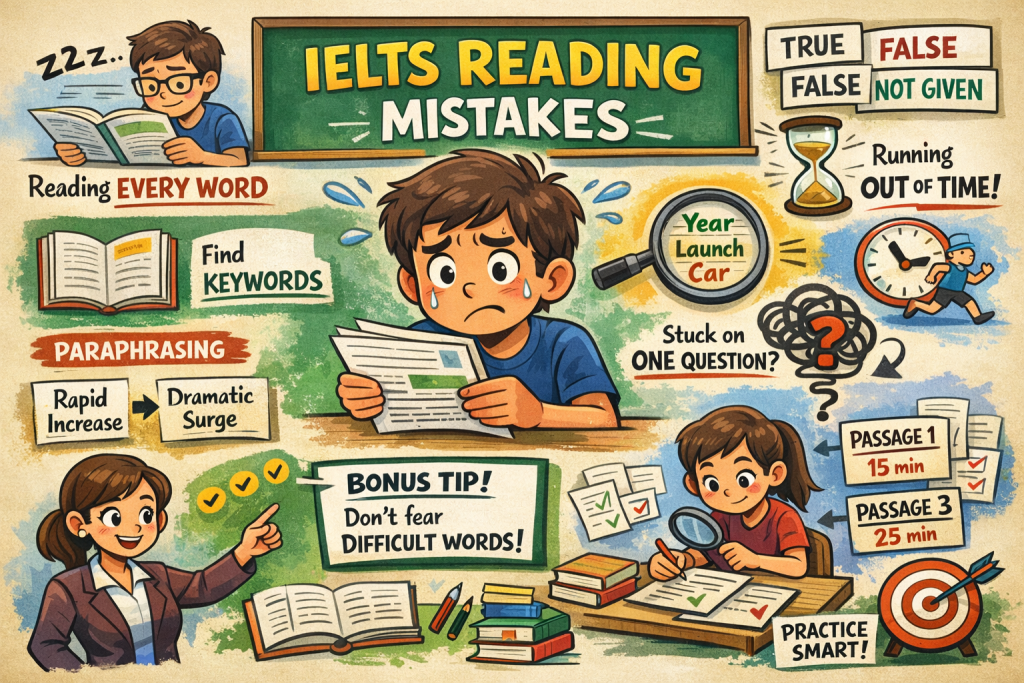
1) Reading Every Word Carefully (Like a Novel)
✕ The Mistake:
Students try to read the entire passage word by word before answering questions.
Why It’s a Problem:
You only get 60 minutes for 3 passages and 40 questions. If you read everything deeply, you’ll run out of time.
✓ The Fix:
Use Skimming + Scanning Strategy
- → Skim first (2–3 minutes):
- Read the title
- Read the first and last paragraph
- Read the first sentence of each paragraph
- → Then go to the questions and scan for keywords.
Remember: IELTS tests your ability to find information, not your ability to read like a literature student.
2) Ignoring Keywords in Questions
✕ The Mistake:
Students read the question but don’t identify important keywords.
Why It’s a Problem:
You won’t know what to look for in the passage.
✓ The Fix:
Underline:
- Names
- Dates
- Numbers
- Specific nouns
- Unique phrases
For example:
“What year did the company launch its first electric vehicle?”
Keywords:
- year
- launch
- first electric vehicle
Now scan the passage only for those concepts.
3) Not Understanding Paraphrasing
✕ The Mistake:
Looking for exact words from the question in the passage.
Why It’s a Problem:
IELTS almost always paraphrases.
Example:
Question says: “rapid increase”
Passage may say: “a dramatic surge”
If you don’t recognize synonyms, you’ll miss the answer.
✓ The Fix:
Improve synonym awareness:
- → Practice matching headings exercises
- → Build a vocabulary notebook
- → After practice tests, analyze paraphrasing patterns
This alone can improve your score by 1 full band.
4) Spending Too Much Time on One Question
✕ The Mistake:
Spending 5–7 minutes on a single difficult question.
Why It’s a Problem:
You lose time for easier questions later.
✓ The Fix:
Use the 1-Minute Rule:
- → If stuck for 60–75 seconds, move on.
- → Mark it.
- → Return later.
Often, when you come back, the answer becomes clearer.
Smart test-takers don’t aim for perfection — they aim for efficiency.
5) Misunderstanding True/False/Not Given
This is one of the biggest score killers.
✕ The Mistake:
Confusing False and Not Given.
Quick Difference:
- TRUE → Information matches the passage.
- FALSE → Information contradicts the passage.
- NOT GIVEN → Information is not mentioned at all.
Example:
Passage:
“The company was founded in 1995.”
Question:
“The company was founded in 1994.”
Answer: FALSE (contradiction)
Question:
“The company was founded in Canada.”
Answer: NOT GIVEN (no information about location)
✓ The Fix:
Ask yourself:
“Is the passage clearly saying this is wrong?”
If no, it’s probably NOT GIVEN.
6) Not Managing Time Properly
✕ The Mistake:
Spending too much time on Passage 1 and rushing Passage 3.
Why It’s a Problem:
Passage 3 is usually the hardest and needs more focus.
✓ Ideal Time Distribution:
- → Passage 1: 15–18 minutes
- → Passage 2: 20 minutes
- → Passage 3: 22–25 minutes
Practice with a timer every time.
No timer = unrealistic preparation.
7) Not Reviewing Mistakes After Practice
✕ The Mistake:
Students complete tests but never analyze errors.
Why It’s a Problem:
You keep repeating the same mistake.
✓ The Fix:
After each test:
- → Check why the correct answer is correct.
- → Identify if the mistake was:
- Vocabulary
- Time pressure
- Careless reading
- Paraphrasing confusion
Improvement happens during review — not during testing.
+ Bonus Tip: Stop Fearing Difficult Words
Many students panic when they see academic vocabulary.
Important truth:
You do NOT need to understand every word to get Band 7+.
Focus on:
- → Sentence meaning
- → Keywords
- → Logical structure
Even native speakers don’t understand 100% of academic texts — and they still answer correctly.
Final Thoughts
IELTS Reading is not about intelligence.
It’s about strategy, awareness, and practice with purpose.
If you’re consistently scoring:
- Band 5–6 → You likely have timing & paraphrasing issues.
- Band 6.5–7 → You need refinement and accuracy control.
- Band 7.5+ → Focus on precision and avoiding careless mistakes.
Work smart, not just hard.
Remember:
The goal is not to read everything. The goal is to find the right answers efficiently.
By Prince Kumar, Office Assistant, C2 Prep