If You’re Scoring 5.5–6, Read This Before Your Next Attempt
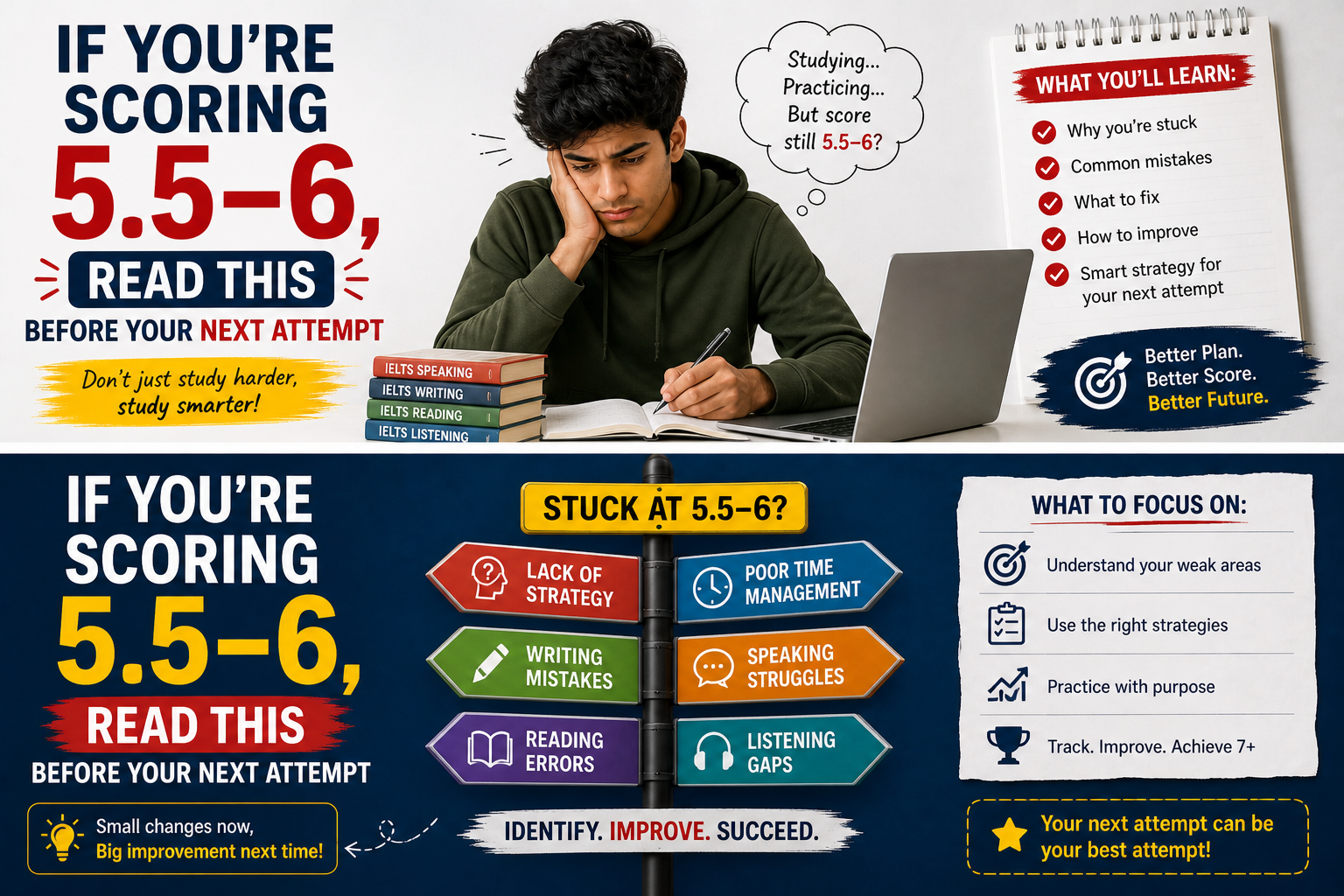
Not bad. But not what you needed.
Maybe your university requires a 6.5. Maybe your visa demands a 7. Whatever the target, you’re sitting in that frustrating middle ground — good enough to pass, not quite good enough to move forward.
Here’s what most students in your position don’t realise: scoring 5.5–6 is actually a turning point, not a ceiling. You already have the foundation. What you’re missing is precision — and that’s very fixable.
This post breaks down exactly what’s keeping you at this band, skill by skill, and what to do before you book that next attempt.
First, Understand What a Band 6 Actually Means
A lot of students treat band scores like grades — as if a 6 just means “you got 60%.” That’s not how IELTS works.
Each band score has a specific descriptor. A Band 6 candidate, according to Cambridge, has an “effective command of the language despite some inaccuracies, inappropriate usage and misunderstandings.” You can generally handle complex language and understand detailed reasoning — but errors creep in, especially under pressure.
A Band 7 candidate, by contrast, has a “good command.” The errors are rare, and they don’t cause problems for the listener or reader.
That gap — from “effective despite errors” to “good command, rare errors” — is exactly what you need to close.
The 4 Most Common Reasons Students Stay at 5.5–6
1. You’re Being Too Safe in Speaking and Writing
At band 5.5–6, most candidates play it safe. Short sentences. Familiar vocabulary. Topics they’ve memorised answers for. This feels secure, but IELTS examiners are specifically trained to look for range and flexibility — your ability to use the language, not just not misuse it.
If every sentence in your Writing Task 2 follows the same structure, or if you give the same rehearsed answer to every Speaking Part 2 topic, your score will stall.
What to do: Deliberately practise “uncomfortable” structures. Use a relative clause. Use a passive construction. Start a sentence with a gerund. Not because it’s fancy — because range is a scoring criterion.
2. Your Vocabulary is Accurate But Generic
You probably avoid mistakes by sticking to words you know well. That’s smart — but it costs you points on Lexical Resource (Writing) and Vocabulary (Speaking).
Band 7 candidates use less common vocabulary naturally and accurately. The key word is naturally. Shoving in a rare word awkwardly is actually worse than using a simpler word correctly.
What to do: Stop learning word lists. Start learning words in context — in phrases, collocations, and topic-specific clusters. Instead of learning “significant,” learn “a significant rise in,” “have a significant impact on,” “no statistically significant difference.”
3. You’re Losing Points on Coherence, Not Content
In Writing, many 5.5–6 candidates have solid ideas but lose marks because their essays are hard to follow. Paragraphs that wander. Linking words used incorrectly (“moreover” at the start of every second sentence). A conclusion that basically repeats the introduction word-for-word.
Coherence and Cohesion is worth 25% of your Writing score. It’s also one of the most improvable areas in a short time.
What to do: Practice writing with one clear idea per paragraph. Your topic sentence should state the idea. The next 2–3 sentences should explain or support it. The final sentence should link forward or conclude the point. That structure alone will lift your Coherence score.
4. You’re Not Listening to the Right Things in Listening and Reading
Many candidates lose marks in Listening because they’re so focused on catching the answer that they miss the surrounding context — and IELTS is full of distractors. A speaker might say “we originally planned to meet on Tuesday” before confirming “but it’s actually Thursday.” If you only heard “Tuesday,” you’re wrong.
In Reading, the issue is often time management. Students spend too long on hard questions and rush the final section, missing easier marks.
What to do: For Listening, practise with transcripts. Listen once, note your answers, then read the transcript and identify every distractor you missed. For Reading, set a timer — 20 minutes per passage, no more. Skipping and coming back is a strategy, not giving up.
A Skill-by-Skill Action Plan
| Skill | Common 5.5–6 Problem | Key Fix Before Your Next Attempt |
|---|---|---|
| Listening | Missing distractors; losing focus mid-section | Transcript analysis after every practice test |
| Reading | Running out of time; over-reading | Strict 20-min per passage; skim for structure first |
| Writing | Generic vocabulary; weak paragraph structure | One idea per paragraph; learn collocations, not word lists |
| Speaking | Over-rehearsed answers; limited grammatical range | Record yourself; practise extending answers with reasons and examples |
What a Band 7 Answer Actually Looks Like (Writing Example)
Here’s a real example. Both sentences express the same idea — but one is Band 6 and one is Band 7.
Band 6:
“Many people think that social media has bad effects on young people. I agree with this opinion because young people use it too much.”
Band 7:
“There is a growing concern that excessive social media use may have a detrimental impact on adolescents, a view I largely share given the mounting evidence around its effects on mental health and attention spans.”
Notice the difference isn’t just vocabulary — it’s sentence complexity, hedging language (“largely,” “may”), and specificity. The Band 7 sentence packs more meaning into one well-controlled structure.
You don’t need to write every sentence like that. But you need to show the examiner you can.
The Speaking Trap Most 5.5–6 Students Fall Into
Speaking is where many students plateau the longest — and the reason is almost always the same: over-preparation of specific topics rather than development of fluency and range.
Memorising model answers for “Describe a place you have visited” or “Talk about a person who inspires you” can actually hurt you. Examiners are trained to recognise rehearsed speech, and when your tone shifts from natural to recited, your fluency score drops.
Worse, if you get an unexpected topic — and you will — you’ll freeze.
What actually works:
- Record yourself answering random Part 2 cue cards cold — no preparation. Listen back and count how many times you pause, repeat a filler word, or use the same sentence structure twice in a row.
- Practise the “PEEL” method out loud: Point → Example → Explanation → Link back. This keeps answers coherent without sounding scripted.
- Work on your Part 3. Most students under-prepare for the abstract discussion in Part 3, which is where Band 7+ scores are made or lost.
How Much Time Do You Actually Need?
This depends on your current weak area, but as a general guide:
- If your gap is mostly in Writing: 6–8 weeks of daily writing practice with proper feedback (not just self-correction) is realistic for a half-band improvement.
- If your gap is in Speaking: 4–6 weeks of consistent speaking practice with a focus on range and fluency — not topic preparation.
- If your gap is in Listening or Reading: 3–4 weeks of strategic practice (timed, with analysis) can yield quick gains since these are skill-based, not language-based.
The biggest mistake students make is booking their next attempt too soon — sometimes within 2–3 weeks — without changing what they’re doing. If you do the same preparation, you’ll get the same result.
Three Things to Do Right Now
Get your Test Report Form and look at sub-scores. Your overall band is an average. Your individual skill scores (Listening, Reading, Writing, Speaking) will tell you exactly where you’re losing points. Work on your weakest skill first — that’s where the biggest gains are.
- Do a diagnostic practice test under real conditions. Timed, alone, no interruptions. Mark it honestly. Then, instead of just noting what you got wrong, write down why you got it wrong. Was it a vocabulary gap? Did you misread the question? Did you run out of time? The “why” is where your study plan comes from.
- Change at least one thing about your preparation strategy. If you’ve been doing practice tests but not reviewing them analytically, start reviewing. If you’ve been focusing on grammar rules but not practising production, start writing and speaking more. More of the same won’t move the needle.
You’re Closer Than You Think
5.5 to 6.5 is a half-band improvement. 6 to 7 is one full band. For most students in this range, that distance is bridgeable in 6–10 weeks with the right approach — not just more hours of study, but smarter study aimed at exactly the right gaps.
The students who get stuck at this level are usually the ones who keep practising without diagnosing. The ones who move through it are the ones who treat each practice session as data — information about what they specifically need to fix.
You already proved you can sit the test and perform under pressure. Now it’s about precision.
If you’d like guidance on exactly where your preparation should focus, get in touch with our team — we’ll help you build a plan that’s specific to your scores and your deadline.
By :- Sarthak Tiwari, Office Assistant, C2 Prep